

This U.S. Army Ordnance Department poster created by Adolph Treidler shows a woman ordnance worker, dressed in Rosie the Riveter style of blue coveralls and red bandana, standing next to a large 75 TN shell. Also, are hats depicting six women’s branches of the military service: WOW, [Woman Ordnance Worker], WAAC [Women’s Army Auxiliary Corps], WAVE [Women Accepted for Volunteer Emergency Service], Army Nurse, Navy Nurse, and Red Cross. Photograph retrieved from the Library of Congress, https://www.loc.gov/item/96502806/
Sept/Oct 2026 (Volume 18, Issue 5)
By Linda Betsinger McCann
While millions of United States Armed Forces servicemen were fighting the Axis powers overseas during World War II, millions of women back home in the U.S. were supporting the war effort by working in factories that were converted from their normal production into making instruments of war for the U.S. military. These women were given the nickname “Rosie the Riveter” and they were desperately needed to manufacture everything from airplanes to clothing for U.S. servicemen during World War II.
“Rosies” not only worked as riveters, but also as welders, drill-press and lathe operators, inspectors, and especially anything dealing with small parts as factories discovered that women handled the intricate work better than men. And like their male counterparts, some paid a high price for their service to the nation as they were killed or disabled working in factories.
In Iowa more than 70 factories had military contracts and they hired thousands of women to turn out items for the war cause. Airplanes, tanks, ammunition and a variety of parts were produced in the Hawkeye State. Many Rosies stayed in Iowa to work in those factories, while others left the state to work in similar factories.

Clockwise from top left: Women working at the John Deere plant in Waterloo in 1943; an employee’s badge from the Chamberlain Corp. in Waterloo; and female employees at a Burlington ammunition factory. Photos courtesy of Linda Betsinger McCann
Two years before the U.S. entered World War II, 72 manufacturing firms in Iowa claimed to be ready to “swing immediately into war production,” according to the Sept. 17, 1939, edition of the Des Moines Sunday Register. The newspaper reported that Des Moines had 11 factories; Davenport and Dubuque each had seven; and Burlington, Sioux City, Bettendorf and Waterloo each had five.
By December 1940, President Franklin D. Roosevelt called for an increase in military production. With the bombing of Pearl Harbor on Dec. 7, 1941, the U.S. entered World War II, and as a result, the nation had to move quickly into wartime production mode. Factories quickly converted into building airplanes, ships, troops’ supplies and manufacturing ammunition. Large production quotas created labor shortages, especially when millions of men joined the military.
In 1943, U.S. Secretary of War Harry Stimson began promoting the “Get Women to Work” campaign. Stimson stated that for the U.S. to win the war it needed to “fully utilize, immediately and effectively, the largest and potentially the finest single source of labor available today—the vast reserve of woman power.”
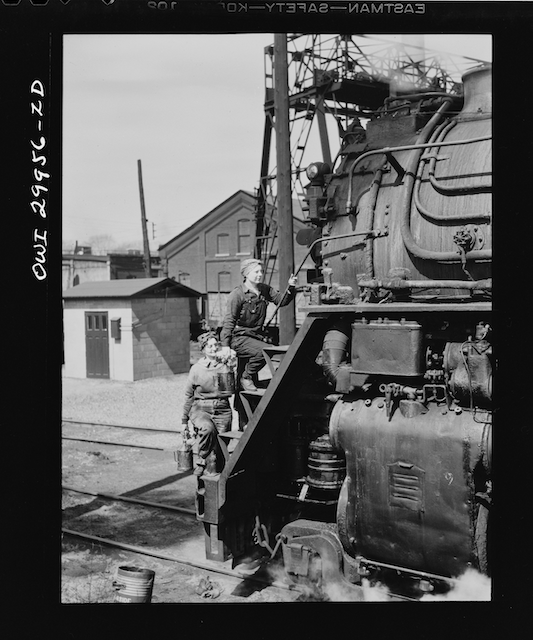
Women wipers of the Chicago and Northwestern railroad cleaning one of the giant locomotives in Clinton in May 1943. Photo by Jack Delano, retrieved from the Library of Congress, https://www.loc.gov/item/2017872311/
More than 310,000 women, for example, were employed in the U.S. aircraft industry in 1943, making up 65 percent of the industry’s total workforce, compared to just one percent in the pre-war years. By 1944, more than six million women had entered the work force. In total, it is estimated that nearly 19 million women held jobs during World War II.
The largest defense contract in Iowa of $10.6 million went to the Iowa Transmission Co. of Waterloo, a subsidiary of the John Deere Co., to manufacture bullet-proof tank transmissions. The highest number of contracts amounting to $1.4 million went to the Boyt Harness Co. in Des Moines for haversacks, gym covers and cartridge belts, according to the Jan. 8, 1942, edition of the Des Moines Register.
In addition to working jobs in which they had no prior experience, women had to adjust to many changes in their personal lives while their husbands were gone including securing child care and rationing their food as the U.S. government applied nationwide restrictions. Price controls began as there were shortages of everything from nylons to housing, and volunteers were needed in communities throughout Iowa ranging from air raid wardens to Red Cross workers.
TO READ THE ENTIRE STORY AND OTHER FASCINATING STORIES ABOUT IOWA HISTORY, subscribe to Iowa History Journal.